Great Post Sent to Me Today
I said: it's sad they thought that kid had a bomb.
She said: they didn't think he had a bomb.
I said: yes, they thought he made a bomb and even called the police.
She said: They just wanted to humiliate a little Muslim boy. They didn't think he had a bomb.
I said: Don't be a conspiracy theorist. They might be a little prejudiced, but I'm sure they thought he had a bomb.
She said: OK. But they didn't evacuate the school, like you do when there's a bomb.
They didn't call a bomb squad - like you do when there's a bomb.
They didn't get as far away from him as possible, like you do when there's a bomb.
Then they put him and the clock in an office: not like you do when there's a bomb
Then they waited with him for the police to arrive, and then they put the clock in the same car as the police.
Then they took pictures of it.
I said: Damn.....They never thought he had a bomb.
Boy arrested at school for building a digital lock
"How did a bunch of complete idiots end up
accidentally running a school? Were you all yanked out of a zoo and
given paychecks? Learning centers are for teaching...not for ruining
innocent people's lives with your racism and pathetic stupidity!..."This
kid is destined to be something great if the dimwits of Irving don't
ruin him first."
--Kevin McKinney
Is there something wrong with teacher culture?
by Maura Larkins
My explanation for the disgraceful incident in Irving, Texas where a boy was arrested for building a clock is that adults in schools so rarely engage in critical thinking. A teacher who engages in critical thinking will most likely be unpopular. There isn't a place for such teachers in the powerful cliques that run schools. I have long wondered why teachers are expected to teach critical thinking to kids when so many of them seem to be incapable of it.
Also, a culture of hostility and contempt toward students is cultivated by many teachers who are zealous in their efforts to catch students being bad--and then to run to the teachers lounge to denounce the children they are paid to nurture.
This culture creates a tendency toward paranoia among teachers and administrators.
Update Sep. 17, 2015:
...Ahmed spoke about his arrest today on ABC News' "Good Morning America," describing how his English teacher and police reacted to his clock, which is still in police custody.
"She saw a clock that, in her opinion, looked like a threat to her,"
Ahmed said of the unnamed teacher. "It felt really weird getting
arrested because I never thought I'd ever get arrested....
When
Ahmed Mohamed went to his high school in Irving, Texas, Monday, he was
so excited. A teenager with dreams of becoming an engineer, he wanted to
show his teacher the digital clock he'd made from a pencil case.
The
14-year-old's day ended not with praise, but punishment, after the
school called police and he was arrested. A photo shows Ahmed, wearing a
NASA t-shirt, looking confused and upset as he's being led out of
school in handcuffs.
"They arrested me and they told me that I committed the crime of a hoax bomb, a fake bomb," the freshman later explained to WFAA after authorities released him..
Discrimination against females in science continues.
An in-house probe at UCLA concluded in 2015 that women face "demeaning" treatment at the Medical School, however, the person responsible, John Mazziotta, was promoted in March to vice-chancellor!!!
See article below showing UCLA Medical School refused to address problems even when a female instructor won a $2.95 million discrimination case in 2004. UCLA didn't mince words at the time: "The university respectfully disagrees
with the verdict, and we do not believe it was supported by the evidence,"
said James E. Holst, UC's general counsel.
Microbiologist Steve Diggle’s contribution to the #distractinglysexy
hashtag used to mock Tim Hunt’s comments about women in science.
Photograph: Steve Diggle/Twitter
‘There should be a rule against women having children in science’
“Following the recent comments made by Tim Hunt, I spent a little
time reminiscing about my experiences as a postdoctoral researcher at a
London University. I started this position full of enthusiasm but it
ended quite swiftly following comments from my principal investigator
(PI), such as:
‘There really should be a rule against women having children in science.’
‘I’m not going to teach you how to do it because you’re probably
going to leave for marriage and children anyway so why waste my time?’
‘Sorry about all the women in this laboratory, but at least they’re good to look at.’
"The former
neurology chairman, John Mazziotta, was promoted in March to vice
chancellor of UCLA’s health sciences and dean of the medical school.
Hiatt’s letter did not mention him and did not say what role Mazziotta
may have had in previous handling of the women’s complaints."
Women
faculty at UCLA's Alzheimer's disease research center faced "a climate
of conflict, tension, hostility and mistrust" for about a decade and
were treated in an "unprofessional, demeaning manner," an investigation
at the campus medical school has found.
The
probe upheld long-pressed complaints from three women faculty that they
were discriminated against by some men in the department and faced
retaliation for reporting breaches in research protocol, Jonathan Hiatt,
the vice dean for faculty, said in a letter sent to staff.
The
result was a significantly negative effect on the center and a working
environment that "compromises our research, teaching and patient care,"
Hiatt wrote.
The March letter, which was obtained by The Times,
did not identify the women who say they were discriminated against nor
the people who they say violated campus rules. Hiatt could not be
reached for comment Friday night.
Dale Tate, a spokeswoman for the
David Geffen School of Medicine, confirmed the authenticity of the
letter but said she could not offer any more details about the
situation.
"While
we cannot comment beyond the contents of the letter since it involves
confidential personnel matters, leadership within the university and the
health system is committed to a work environment that is welcoming and
free from discrimination of any kind. The letter was intended as an
internal communication to describe the measures taken by the university
in response to serious concerns brought forward in good faith by female
members of the faculty," she said in a statement.
In
the letter, Hiatt wrote that he brought in an external investigator to
look into the complaints, interview current and former faculty and
review documents. The resulting report was finished in October and
declared that the women faculty "had correctly identified and documented
the unprofessional behavior to which they had been subjected" and had
brought their complaints to the attention of administrators numerous
times without a proper response, he said.
Hiatt said he has made
some changes in the department of neurology in response to the
complaints. Without saying that anyone had been directly disciplined, he
noted that the department of neurology has a new interim chair,
professor Marie-Francoise Chesselet, and that another professor has been
appointed as a monitor for issues of gender and equity. He said he is
committed to a fair and "welcoming" school workplace. The former
neurology chairman, John Mazziotta, was promoted in March to vice
chancellor of UCLA’s health sciences and dean of the medical school.
Hiatt’s letter did not mention him and did not say what role Mazziotta
may have had in previous handling of the women’s complaints.
The
Alzheimer's research center has about 10 professors working there,
according to its website, and is devoted to improving the quality of
life for patients and caregivers, to develop new medications, treatments
and improved and earlier diagnoses.
August 05, 2004|Rebecca Trounson | Los Angeles Times Staff Writer
A
former clinical instructor at the UCLA School of Medicine has won a
$2.95-million judgment against the University of California from a
Superior Court jury in a sex discrimination and retaliation case.
The
jury, in Los Angeles County Superior Court, found that UCLA had
discriminated against Janet Conney in her efforts to obtain a
tenure-track position at the university, then retaliated against her
when she complained.
Conney, 40, had worked at UCLA's
Neuropsychiatric Institute and Hospital from 1999 to 2002 after she
completed a year of specialty training at the university in geriatric
psychiatry. She filed suit against the institute and UC's governing
board in 2003, claiming that her supervisors had discriminated against
her on the basis of gender when they decided not to promote her from
clinical instructor to assistant clinical professor...
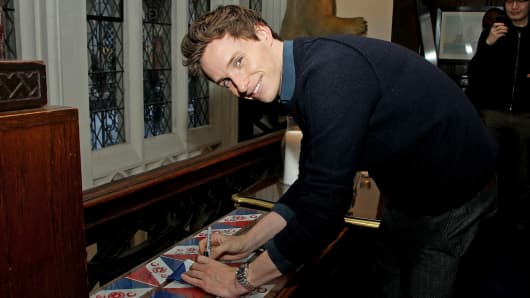
Eddie Redmayne is shown in this Nov. 19, 2014 photo.
Hollywood is being overtaken by mutants and meta-humans,
making it hard for a garden-variety astrophysicist to catch a break in
the movies.
With that in mind, even producing a vehicle about
one of the world's most recognizable scholars was certainly no easy
feat. That assessment comes directly from the man who wrote the script
of author and scholar Stephen Hawking's biopic, "The Theory of
Everything," which has been showing in theaters for nearly a month.
"It took 10 years to get this film off the ground," Anthony McCarten told CNBC in a response to emailed questions.
The difficulties of moving "Theory" from script to
screen underscore the challenges facing art house movies, which are
colliding with certain economic realities, he said. For scripts that
don't feature well-known characters or A-list actors, the road to a
green light can be even tougher, as big budget super heroes crowd out
independent flicks.
"This was partly to do with the assumption that,
no matter how compelling the central characters or how unprecedented
their journey, physics and the travails of [Hawking's] disease…were
almost certainly not going to be a recipe for big box office numbers,"
McCarten said. Read MoreArtificial intelligence could end mankind: Hawking
The Explorer Society of New York
The screenplay charts Hawking's development as a young
physics student at the University Cambridge—where he is diagnosed with
amyotrophic lateral sclerosis (ALS) and given an initial prognosis of
two years to live—to his marriage and the penning of his definitive
tome, "A Brief History of Time."
When it debuted early this month, "Theory" arrived
at an inauspicious time at the U.S. box office. The Thanksgiving to
Christmas stretch normally gets swallowed by large budget, special
effects heavy "popcorn" movies that serve as tentpoles for the major
studios.
"Theory" was forced to share its premiere weekend
with two movie juggernauts, "Interstellar" and animated film "Big Hero
Six," which combined for a debut of more than $100 million.
Meanwhile, the fortunes of indie movies, even
those with cultural icons like Steve Jobs at their core, are becoming
prohibitively daunting as Tinseltown promotes a blitz of tentpoles. The
10 top-grossing independent movies of 2013 combined to earn more than
$230 million, according to figures from Indiewire.com. Read MoreSony Pictures drops Steve Jobs film
Still, that amount is barely a tenth of the $2.3 billion
this year's box-office behemoths have reaped—all of which were science
fiction, cartoon and comic adaptation spectacles like "Guardians of the
Galaxy," "Captain America," and "Maleficent."
Conversely, independent movie makers are burdened
with the task of challenging "the myth that audiences seek only
spectacle," McCarten told CNBC.
"What they want, and have always wanted, is an
immersive, emotional experience that surprises, delights and educates.
How seldom these experiences involve airborne men in tights with special
powers," he quipped.
Hawking his own super hero?
Hawking—a theoretical physicist and globally renowned
author—is certainly no ordinary mortal. Given a wealth of
accomplishments and a life story that personifies overcoming long odds,
one could easily make a case for Hawking being a superhero himself.
The emotional plot of "Theory" illustrates how a
physically slight, brilliant academic who's self-confident enough to
delve into the universe's deepest mysteries—not unlike Reed Richards of the "Fantastic Four" (also coming to a theater near you in 2015).
Simultaneously, Hawking conquers the ravages of a
debilitating disease (Wolverine's healing factor, anyone?) while
capturing the affections of his own version of Superman's Lois Lane. In
the movie, Jane Hawking, played by Felicity Jones, seems to be one of
the most comely women on Cambridge's campus.
"He's continually defied expectation, and there are many heroic qualities to him for sure," Eddie Redmayne, who played Hawking in "Theory", told CNBC in a brief interview in New York last week. "It was a real treat to get to enter his orbit." But in an environment where even the story of
Margaret Thatcher, the world bestriding former U.K. prime minister, can
barely crack $100 million in movie ticket receipts, does a Cambridge
scholar stand a reasonable chance to earn both accolades and ticket
sales? Read MoreEven 'Big Heroes' need big hearts: Disney
Although "Theory" has pulled in a scant $4 million
in sales domestically, McCarten insists indie films can still carve
their own niche—and stand alongside the computer generated images of
their big-budget counterparts.
"Of course there is a market, and every year the
point is made again and again, in people's hearts and at the Oscars and
at the box-office, that people want inspiring true stories," he said.
"My job, and the job of everyone interested in
grown-up film-making, is to make sure we get it to them: certified
fresh, dazzling, remarkable and…true," McCarten added.
VATICAN
CITY — Pope Francis has waded into the controversial debate over the
origins of human life, saying the big bang theory did not contradict the
role of a divine creator, but even required it.
The pope
was addressing the plenary assembly of the Pontifical Academy of
Sciences, which gathered Monday at the Vatican to discuss "Evolving
Concepts of Nature."
"When we read about Creation in Genesis, we
run the risk of imagining God was a magician, with a magic wand able to
do everything. But that is not so," Francis said.
"He created
human beings and let them develop according to the internal laws that he
gave to each one so they would reach their fulfillment."
Francis
said the beginning of the world was not "a work of chaos" but created
from a principle of love. He said sometimes competing beliefs in
creation and evolution could co-exist.
Pope Francis tells an audience that the Big Bang does not contradict
the "creative intervention of God". He says, "on the contrary, it
requires it". Rough Cut (no reporter narration).
Newslook
"God is
not a divine being or a magician, but the Creator who brought
everything to life," the pope said. "Evolution in nature is not
inconsistent with the notion of creation, because evolution requires the
creation of beings that evolve."
Unlike much of evangelical
Protestantism in the U.S., Catholic teaching traditionally has not been
at odds with evolution. In 1950, Pope Pius XII proclaimed there was no
opposition between evolution and Catholic doctrine. In 1996, St. John
Paul II endorsed Pius' statement.
Some wondered if Pope Emeritus
Benedict XVI wanted to change that when he and some acolytes seemed to
endorse the theory of intelligent design, the idea that the world is too
complex to have evolved according to Charles Darwin's theory of natural
selection.
Cardinal Christoph Schoenborn of Vienna, a close associate of Benedict, penned a widely noticed 2005 op-ed in The New York Times
that said "Evolution in the sense of common ancestry might be true, but
evolution in the neo-Darwinian sense — an unguided, unplanned process …
is not."
Giovanni Bignami, a professor and president of Italy's
National Institute for Astrophysics, welcomed Francis' comments, saying
he had buried the "pseudo theories" of creationists.
"The pope's
statement is significant," Bignami told Italian news agency Adnkronos.
"We are the direct descendants from the Big Bang that created the
universe. Evolution came from creation."
Giulio Giorello,
professor of the philosophy of science at Milan's University degli
Studi, said he believed Francis was "trying to reduce the emotion of
dispute or presumed disputes" with science.
A 1975 image of smallpox. Two
of six vials of smallpox stored at the National Institutes of Health
since 1954 contained live virus capable of infecting people, it was
announced Friday.CDC, via Associated Press
After
potentially serious back-to-back laboratory accidents, federal health
officials announced Friday that they had temporarily closed the flu and
anthrax laboratories at the Centers for Disease Control and Prevention
in Atlanta and halted shipments of all infectious agents from the
agency’s highest-security labs.
The
accidents, and the C.D.C.’s emphatic response to them, could have
important consequences for the many laboratories that store high-risk
agents and the few that, even more controversially, specialize in making
them more dangerous for research purposes.
If
the C.D.C. — which the agency’s director, Dr. Thomas Frieden, called
“the reference laboratory to the world” — had multiple accidents that
could, in theory, have killed both staff members and people outside,
there will undoubtedly be calls for stricter controls on other
university, military and private laboratories.
In one episode last month, at least 62 C.D.C. employees may have been exposed to
live anthrax bacteria after potentially infectious samples were sent to
laboratories unequipped to handle them. Employees not wearing
protective gear worked with bacteria that were supposed to have been
killed but may not have been. All were offered a vaccine and
antibiotics, and the agency said it believed no one was in danger.
In
a second accident, disclosed Friday, a C.D.C. lab accidentally
contaminated a relatively benign flu sample with a dangerous H5N1 bird
flu strain that has killed 386 people since 2003. Fortunately, a United
States Agriculture Department laboratory realized that the strain was
more dangerous than expected and alerted the C.D.C.
All
the samples will be destroyed as soon as the genomes of the virus in
them can be sequenced. The N.I.H. will scour its freezers and storerooms
for other dangerous material, he said.
“These
events revealed totally unacceptable behavior,” Dr. Frieden said. “They
should never have happened. I’m upset, I’m angry, I’ve lost sleep over
this, and I’m working on it until the issue is resolved.”
The
anthrax and flu labs will remain closed until new procedures are
imposed, Dr. Frieden said. For the flu lab, that will be finished in
time for vaccine preparation for next winter’s flu season, he said.
Dr.
William Schaffner, the head of preventive medicine at Vanderbilt
University’s medical school, said he thought all American labs should
stop shipping all hazardous agents until they have reviewed their safety
procedures. Although there is no obvious way to force them to do that,
he said, the federal grants that most labs depend on “could be the
stick.”
Dr.
Frieden himself suggested that the accidents had implications for labs
beyond his agency, arguing that the world needs to reduce to absolute
minimums the number of labs handling dangerous agents, the number of
staff members involved and the number of agents circulating.
Scientists
doing the most controversial work — efforts to make pathogens more
lethal or more transmissible — say the research helps predict mutations
that might arise in nature so that vaccines can be created. But other
scientists feel that creating superstrains is unacceptably dangerous
because lab accidents are more common than is often acknowledged, as Dr.
Frieden’s announcement indicated.
The revelations at the C.D.C. renewed calls for a moratorium by opponents of such “gain of function” research.
“This
has been a nonstop series of bombshells, and this news about
contamination with H5N1 is just incredible,” said Peter Hale, founder of
the Foundation for Vaccine Research, which lobbies for more funding for
vaccines but opposes “gain of function” research. “You can have all the
safety procedures in the world, but you can’t provide for human error.”
At
the C.D.C. itself, Dr. Frieden said, staff members who knowingly failed
to follow procedures or who failed to report dangerous incidents will
be disciplined. A committee of experts will be convened to revise
procedures.
In
the flu-related incident, a C.D.C. lab accidentally contaminated a
sample of less-dangerous H9N2 bird flu, which it was preparing for
shipment to an Agriculture Department laboratory, with the H5N1 bird flu
strain.
Though
the contamination was discovered on May 23, Dr. Frieden said that he
was dismayed to discover that senior C.D.C. officials were not informed
until July 7, and that he was told only 48 hours ago.
Nonetheless,
he said, “we have a high degree of confidence that no one was exposed.”
The flu material was handled in high-biosafety-level labs in both
agencies, and the workers wore breathing apparatuses.
In theory, the flu-related accident could have been much worse than the anthrax one.
Anthrax
can kill those who inhale it, but is not normally transmitted between
humans, so an infected laboratory worker presumably could not have gone
home and passed it on. H5N1 bird flu has killed about 60 percent of
those known to have caught it, almost always after contact with poultry.
Although it does not easily jump from person to person, it is thought
to have done so several times.
The
anthrax episode took place on June 5 in the agency’s bioterrorism rapid
response lab as part of testing a new mass spectrometry method.
The
new C.D.C. report found several errors: A scientist used a dangerous
anthrax strain when a safer one would have sufficed, had not read
relevant studies and used an unapproved chemical killing method.
The
error was discovered by accident. The door to an autoclave that would
have sterilized samples taken for safety tests was stuck, so they were
left in an incubator for days longer than normal. Only then did a lab
technician notice that bacteria believed to be dead were growing.
Later
tests done at the C.D.C. and at a Michigan State Health Department lab
as part of the investigation confirmed that the chemical method would
have killed any live, growing anthrax in the samples that were sent out,
but might not have killed all spores, which are surrounded by a hard
shell and can also be lethal.
Although
anthrax terrifies laymen, “when you work with it day in and day out,
you can get a little careless,” Dr. Frieden said. “The culture of safety
needs to improve at some C.D.C. laboratories.”
How do school officials expect students to understand science when they barely understand that the earth is not flat?
Is the average American teacher subpar? Yes.
Obviously, the concept of the earth orbiting the sun is one that SHOULD BE taught with a living, moving demonstration with objects such as a basketball for Jupiter, a marble for the earth, etc.. The sun would ideally be eight feet in diameter, but balls that size are hard to come by. I myself used something smaller for the three-dimensional demonstration, and then I put up a bulletin board with part of a yellow butcher paper sun (with butcher paper flames). Also, the rotation of the earth on its axis should be taught by letting kids see (or, better yet, carry!) a globe that is turned slowly as it moves around the "sun" (which should be the biggest, roundest, most orange object the teacher can come up with).
What excuse is there for the legions of teachers who don't bother to make sure that their students understand these concepts? I am frequently appalled by the mental laziness of teachers.
As a teacher I was amazed at the percentage of my fellow teachers who would stand up in front of the class and recite a fact, and then think that their job was done regarding that fact.
Parents: most of your kids are receiving inadequate instruction in basic concepts. I urge you to support Common Core, and to hold teachers accountable for learning how to teach it. DON'T FALL FOR ALL THE WHINING THAT TEACHERS ARE DOING. They are college graduates. They should be able to figure out how to teach basic concepts.
A quarter of Americans surveyed could not correctly answer that the Earth revolves around the sun and not the other way around, according to a report out Friday from the National Science Foundation.
The survey of 2,200 people in the United States was conducted by the NSF in 2012 and released on Friday at an annual meeting of the American Association for the Advancement of Science in Chicago.
To the question "Does the Earth go around the Sun, or does the Sun go around the Earth," 26 percent of those surveyed answered incorrectly.
In the same survey, just 39 percent answered correctly (true) that "The universe began with a huge explosion" and only 48 percent said "Human beings, as we know them today, developed from earlier species of animals."
Just over half understood that antibiotics are not effective against viruses.
As alarming as some of those deficits in science knowledge might appear, Americans fared better on several of the questions than similar, but older surveys of their Chinese and European counterparts.
Only 66 percent of people in a 2005 European Union poll answered the basic astronomy answer correctly. However, both China and the EU fared significantly better (66 percent and 70 percent, respectively) on the question about human evolution.
In a survey compiled by the National Opinion Research Center from various sources, Americans seemed to generally support science research and expressed the greatest interest in new medical discoveries and local school issues related to science. They were least interested in space exploration, agricultural developments and international and foreign policy issues related to science
It appears that science is prevailing in the latest battle over Texas schoolbooks.
Though earlier this year several of the state’s textbook reviewers called for biology textbooks to discuss creationism, publishers are not complying with those requests, according to the Texas Freedom Network. The nonpartisan watchdog examined material made public by the Texas Education Agency and found that publishers are sticking with teaching evolution.
Citizens who serve on the Texas review panels are charged with making suggestions about proposed classroom texts that are being considered for the state's list of “approved” schoolbooks. While most reviewers on this year’s biology panel made routine, noncontroversial suggestions, some took issue with the fact that the proposed books did not include information about creationism while focusing on evolution.
However, information that publishers submitted to the Texas Education Agency show they are not incorporating the suggestions about "creation science" and plan to print books free of references to the theory of intelligent design.
“This is a very welcome development for everyone who opposes teaching phony science about evolution in our kid’s public schools,” said Texas Freedom Network President Kathy Miller in a press release. “Texas parents can applaud these publishers for standing up to pressure from politicians and activists who want to put their personal beliefs ahead of giving Texas students a 21st-century science education.”
Josh Rosenau, the programs and policy director at the National Center for Science Education, also declared the publishers' response a victory for science.
“They didn’t put in anything creationist or dangerous, so I’m prepared to call this a victory for the publishers,” he told The Huffington Post. “They stood strong against the pressure of the reviewers.”
The right-wing majority on the Texas State Board of Education wants to revise the state's standards for science textbooks to require the addition of religious pseudoscience in biology.
Because of the scale of production of these textbooks, the dictates of the Texas Board of Education may be included in textbooks used by millions of students in other states.
We won’t change the minds of theocrats at the Texas Board of Education. But textbook publishers can refuse to make these changes, or pull out of the state's business altogether.
Join Daily Kos and CREDO in telling textbook publishers to stand up to the right-wing ideologues on the Texas State Board of Education.
Click HERE to send this message to all textbook publishers:
"Science textbooks should provide our children with the best and most broadly accepted science information. It is unacceptable to cave to right-wing politicians and include religious pseudoscience in your publications."
HIV research. Cardiovascular disease research. Diabetes research. Research that could improve our treatment of everything from the common cold to foot-and-mouth disease, from muscle injuries to muscular dystrophy.
Those are just a few of the projects now underway that are seriously endangered by the sequester's cuts to science funding, and the results could be catastrophic.
Under George W. Bush, funding for the National Institutes of Health rose to $30.8 billion, and under President Obama, the stimulus included $10.4 billion in additional funding. Now, with NIH funding falling to $29.1 billion, scientists interviewed by Huffington Post's Sam Stein spoke of having to cut salaries or cut lab staff altogether, of seeing scientists choose jobs in other countries or other fields rather than face the circumstances in research science in the U.S., and of having to consider euthanizing their lab mice.
These aren't just the threats of a brief period in time:
"Medical research is not like building widgets. We cannot turn it on and off," [the Medical College of Wisconsin's Dr. William Jackson] said noting that, among other things, his staff would move on and his project would be tarred as unsuccessful.
And if staff move on to other countries or out of science altogether, that could create a brain drain that will weaken scientific research in the U.S. for a generation or more. Like so many other austerity-driven policies, it's appallingly shortsighted. But "austerity-driven and appallingly shortsighted" is among the top contenders for the motto of today's Republican party, so much of this research is and is likely to remain endangered.
Lise Meitner
From Wikipedia, the free encyclopedia
Lise Meitner (7 November 1878 – 27 October 1968) was an Austrian, later Swedish, physicist who worked on radioactivity and nuclear physics.[4] Meitner was part of the team that discovered nuclear fission, an achievement for which her colleague Otto Hahn was awarded the Nobel Prize. [5] Meitner is often mentioned as one of the most glaring examples of women's scientific achievement overlooked by the Nobel committee.[6][7][8] A 1997 Physics Today study concluded that Meitner's omission was "a rare instance in which personal negative opinions apparently led to the exclusion of a deserving scientist" from the Nobel.[9] Element 109, Meitnerium, is named in her honour.
Meitner was born into a Jewish family as the third of eight children in Vienna... As an adult, she converted to Christianity, following Lutheranism,[1][15] and being baptized in 1908.
When Adolf Hitler came to power in 1933, Meitner was acting director of the Institute for Chemistry. Although she was protected by her Austrian citizenship, all other Jewish scientists, including her nephew Otto Frisch, Fritz Haber, Leó Szilárd and many other eminent figures, were dismissed or forced to resign from their posts...
After the Anschluss, her situation became desperate. In July 1938, Meitner, with help from the Dutch physicists Dirk Coster and Adriaan Fokker, escaped to the Netherlands. She was forced to travel under cover to the Dutch border, where Coster persuaded German immigration officers that she had permission to travel to the Netherlands. She reached safety, though without her possessions. Meitner later said that she left Germany forever with 10 marks in her purse.
In it, she combined the theories of Gottfried Leibniz and the practical observations of Willem 's Gravesande to show that the energy of a moving object is proportional not to its velocity, as had previously been believed by Newton, Voltaire and others, but to the square of its velocity. (In classical physics, the correct formula is Ek = 1⁄2mv², where Ek is the kinetic energy of an object, m its mass and v its velocity.)
[edit]Translation and commentary on Newton's Principia
In 1749, the year of her death, she completed the work regarded as her outstanding achievement: her translation into French, with her commentary, of Newton’s Principia Mathematica, including her derivation of the notion of conservation of energy from its principles of mechanics. Published ten years after her death, today du Châtelet's translation of Principia Mathematica is still the standard translation of the work into French.
Speaker John Boehner should remove Rep. Todd Akin from the House Science and Technology Committee, and apologize for having made such a foolish decision in the first place. But maybe it wasn't foolish. Maybe it was calculated with the purpose of suppressing science.
Republican Congressman Todd Akin told a Missouri news station:
"First of all, from what I understand from doctors [pregnancy from rape] is really rare... If it's a legitimate rape, the female body has ways to try to shut that whole thing down."
Someone who believes nonsense like this has no part overseeing science policy.
A new law in North Carolina will ban the state from basing coastal policies on the latest scientific predictions of how much the sea level will rise, prompting environmentalists to accuse the state of disrespecting climate science.
The law has put the state in the spotlight for what critics have called nearsightedness and climate change denial, but its proponents said the state needed to put a moratorium on predictions of sea level rise until scientific techniques improve.
The law was drafted in response to an estimate by the state's Coastal Resources Commission (CRC) that the sea level will rise by 39 inches in the next century, prompting fears of costlier home insurance and accusations of anti-development alarmism among residents and developers in the state's coastal Outer Banks region.
Democratic Gov. Bev Perdue had until Thursday to act on the bill known as House Bill 819, but she decided to let it become law by doing nothing.
The bill's passage in June triggered nationwide scorn by those who argued that the state was deliberately blinding itself to the effects of climate change. In a segment on the "Colbert Report," comedian Stephen Colbert mocked North Carolina lawmakers' efforts as an attempt to outlaw science.
"If your science gives you a result you don't like, pass a law saying the result is illegal. Problem solved," he joked.
The law, which began as a routine regulation on development permits but quickly grew controversial after the sea-level provision was added, restricts all sea-level predictions used to guide state policies for the next four years to those based on "historical data."
Tom Thompson, president of NC-20, a coastal development group and a key supporter of the law, said the science used to make the 39-inch prediction was flawed, and added that the resources commission failed to consider the economic consequences of preparing the coast for a one-meter rise in sea level, under which up to 2,000 square miles would be threatened.
A projection map showing land along the coast underwater would place the permits of many planned development projects in jeopardy...
Ainissa Ramirez giving a TED Talk. Photo: James Duncan Davidson
Ainissa Ramirez, a Yale University materials scientist, likes to call herself a science evangelist, and her passion and expertise at science education is unparalleled. So this week, with the announcement about the discovery of the Higgs Boson, was both exciting–because of an amazing opportunity–and frustrating–because she thought the science world largely blew it.
Here’s what you need to know about the God Particle.
The Higgs boson (Higgs is a guy’s name, BTW, and a boson is a particle that’s smaller than an atom) is the biggest scientific discovery of the 21st Century. Period.
This discovery is up there with Copernicus. If we did not find the Higgs boson, everything that we understood about how the universe works would have been wrong. We would have had nice equations that describe things we observed in the world, but they would have been crap. That would have been $10 billion flushed down the toilet with the creation of the Large Hadron Collider (LHC) and we would have gone back to the drawing board with our tail between our legs after fifty years of an aimless pursuit.
It was a big gamble, and we won. It is that big...
So what’s the problem?
One of the founders of the Higgs theory, Gerald Guralnik, was quoted in the New York Times saying he was glad to be at a physics meeting “where there is applause, like a football game.”
The problem is that it’s only physicists that are excited. A few thousand scientists (less than 1 percent of the population) are losing their minds, not taking any calls, getting buzzed in the middle of the day, and crying and hugging each other.
The rest of society is trying to figure out why this is a big whoop.
The biggest discovery of the 21st century, which connects you (and the world and the universe) to the Big Bang, was barely a whimper to over 99 percent of the population.
As Strother Martin said in Cool Hand Luke, “ What we’ve got here is a failure to communicate.”
I think the nerds got it wrong by not inviting everyone to the party. The biggest discovery of the 21st century may actually widen the gap between scientists and the general public...
I think we should do a better job at teaching science, technology, engineering, and math (STEM) using events such as this as a catalyst. Since science is right now part of the national conversation, let’s strike while the iron is hot and create ways to get more people excited about science...
CERN should have hired a PR firm to develop a website for the general public on the Higgs Boson. Maybe CERN should have hired a TV personality to be a spokesperson...
Are you part of the “radical fringe”? According to an ad campaign by the Heartland Institute, if you believe in climate change, you’re a radical on par with the likes of Osama bin Laden, the Unabomber, and notorious mass-murderer Charles Manson.
An ad campaign planned by the corporate front-group the Heartland Institute — which is funded in part by Microsoft and Pfizer – features the faces of these notorious killers alongside the phrase “I still believe in Global Warming. Do you?”
Tell Microsoft, Pfizer, and Heartland’s other funders to stop funding Heartland and its dirty climate change denier smears.
Even as people are literally dying from increased flooding, drought, freak storms, and other climate impacts around the world, the fossil fuel industry continues to deny that climate change even exists. Their strategy has been incredibly effective — they’ve stopped the US from taking any serious action to end its addiction to oil and coal, which in turn has made it impossible for the world to reach a global climate treaty. And Heartland, a key climate change denier, also depends on Microsoft, Pfizer, and other corporations who claim they believe in climate change out of one side of their mouth — while simultaneously funding an organization that runs despicable ads like these out of the other side. That’s why we’re joining up with our friends at Forcast the Facts to call for corporations to stop funding Heartland.
The Heartland Institute has a long history of playing dirty. Last year, Heartland was caught trying to sneak industry-written pro-coal propaganda into elementary schools, and previously they have acted as hired guns for the cigarette industry, distributing a paper titled “Joe Camel is Innocent!”.
Corporations have begun fleeing from Heartland. In March, General Motors announced it would no longer fund Heartland. Just yesterday, Diageo — the company behind Guinness, Smirnoff, Johnny Walker, and other brands — also announced they were pulling funding. Now is the time to give Microsoft, Pfizer, and Heartland’s other funders — many of whom have explicitly stated they care about fighting climate change — a push to follow GM and Diageo’s lead.
Congratulations to California education for ranking higher than Mississippi in science knowledge at the 4th and 8th grade! The bad news is that Mississippi is the only state where California ranked higher.
Almost every year, the US Department of Education issues the National Report Card on one or two subjects. This recent ranking was the result of testing 150,000 students in each of two grades, 4th and 8th. (Since a Gallup Poll seldom polls more than 1,500 people to be statistically relevant, 300,000 students is a really good testing sample.)
Last year the reported subjects covered were math and writing, and California stood higher than several states, but still finished only 46, 47 and 48, depending on subject and grade.
The new federal report on science knowledge includes a statistical breakdown of states in addition to their standing. For each state there is a breakdown by free lunches, disabilities, ethnicity, English learners and several other categories. Twelfth graders were added this year, but they were underrepresented in the testing (only 11,000 or so), and there was no breakdown by state.
There are several problems here: the results in science, the trend results and the lack of reporting on the subject. Looking at results back a decade shows similar results in different subjects and almost no reporting on the subject in California, although newspapers do usually carry an Associated Press release annually on the aggregate national scores.
Unfortunately, because California media generally ignores the dismal California results, California parents, teachers, and administrators do not face questioning about the obvious: demonstrated failure of the California education system. Allen Hemphill lives in Escondido.
San Diego Unified did better than the average for large urban school districts on a national science test, ranking fourth out of 17 big city districts in the percentage of students scoring proficient or above.
That may not be surprising, since San Diego Unified also has fewer students poor enough to get free or reduced price lunches than the average big city district, something that tends to make San Diego Unified look good when compared to other urban school systems.
But San Diego Unified also had some of the biggest achievement gaps between its white students and their Hispanic and black classmates, as well as economically disadvantaged students and better off ones, according to an analysis done by the school district itself. Boys also outperform girls.
And even with some of the highest scores among urban districts, San Diego has a way to go, with only 29 percent of fourth graders and 20 percent of eighth graders scoring proficient or advanced on the exam.
...Keep in mind, though, that California lagged near the bottom nationwide on these same science tests, which means San Diego was still behind national scores in both fourth and eighth grade.
Apparently 79-year-old Nobel Prize winner James Watson (co-discoverer of the double-helix structure of DNA) doesn't get out much.
He's spent too much time locked up in the lab with white scientists. He hasn't met a scientific sampling of blacks.
He seems to think you have to be smart to be successful, and you have to be white to be smart.
I know lots of successful people who are as simple as celery.
And lots of white people who are puzzled from morning until night, decade after decade.
Recently I read an article about how shrinking frontal lobes cause people to lose their inhibitions as they get older, resulting in a rise in racist language. I'm guessing that's what's happening to Mr. Watson.
ScientificAmerican.com September 07, 2007 By JR Minkel
Mysterious Honeybee Disappearance Linked to Rare Virus
Researchers isolate possible cause of "colony collapse disorder" but stress that other explanations are still in play
Bees sampled from beekeeping operations afflicted with the perplexing colony collapse disorder have turned up a possible cause: a bee virus discovered recently in Israel.
The mystery illness that has bedeviled U.S. beekeepers since 2006 may stem from a bee virus that apparently spread to the U.S. from Australia three years ago, according to a new study that marks the first big break in the puzzling case of the disappearing bees.
Researchers performed a sophisticated genetic comparison of healthy and diseased U.S. colonies that revealed the presence of Israeli acute paralysis virus (IAPV), an obscure but lethal bee bug, in almost all beekeeping operations affected by "colony collapse disorder" (CCD), but in only a single healthy one they examined.
"We haven't proven this is the cause. It is a candidate for being a trigger for CCD," says W. Ian Lipkin, director of the center for infection and immunology at Columbia University's Mailman School of Public Health, one of the study's lead members. The disorder may also result from a combination of poor nutrition, pesticides and other factors, including infection, Lipkin and his colleagues say. They add that time-consuming tests are needed to determine whether IAPV can trigger CCD alone or in concert with other stressors, or whether certain combinations of stressors instead make hives vulnerable to the virus.
Israeli virologists discovered IAPV three years ago after investigating unexplained cases of dead bees piled in front of hives. The new study found the virus in samples of Australian bees, which were first imported to the U.S. three years ago...
Late last year, reports surfaced that adult honeybees were mysteriously abandoning commercial colonies, leaving ghost hives full of honey, larvae and unattended queens. The disorder wiped out an average of 45 percent of bees among the 23 percent of commercial U.S. beekeepers affected last winter...
Clues to Rising Seas Are Hidden in Polar Ice By Juliet Eilperin Washington Post July 16, 2007
Few consequences of global warming pose as severe a threat to human society as sea-level rise. But scientists have yet to figure out how to predict it.
And not knowing what to expect, policymakers and others are hamstrung in considering how to try to prevent it or prepare for it.
To calculate sea-level rise, the key thing researchers need to understand is the behavior of the major ice sheets that cover Greenland and Antarctica. The disintegration of one would dramatically raise the ocean. But while computer models now yield an increasingly sophisticated understanding of how a warming atmosphere would behave, such models have yet to fully encapsulate the complex processes that regulate ice sheet behavior...