Showing posts with label Internet. Show all posts

Friday, July 04, 2014

Update: Google resists a recent court decision in Europe ordering Google to remove results from Internet searches

UPDATE: GOOGLE REVERSES DECISION TO REMOVE NEWSPAPER LINKS

Google reverses decision to delete British newspaper links
Jul 4, 2014
(Reuters)

Google Inc on Thursday reversed its decision to remove several links to stories in Britain's Guardian newspaper, underscoring the difficulty the search engine is having implementing Europe's "right to be forgotten" ruling.

The Guardian protested the removal of its stories describing how a soccer referee lied about reversing a penalty decision. It was unclear who asked Google to remove the stories.

Separately, Google has not restored links to a BBC article that described how former Merrill Lynch Chief Executive Officer E. Stanley O'Neal was ousted after the investment bank racked up billions of dollars in losses.

The incidents underscore the uncertainty around how Google intends to adhere to a May European court ruling that gave its citizens the "right to be forgotten:" to request the scrubbing of links to articles that pop up under a name search.

Privacy advocates say the backlash around press censorship highlight the potential dangers of the ruling and its unwieldiness in practice. That in turn may benefit Google by stirring debate about the soundness of the ruling, which the Internet search leader criticized the ruling from the outset.

Google, which has received more than 70,000 requests, began acting upon them in past days. And it notified the BBC and the Guardian, which in turn publicized the moves.

The incidents suggest that requesting removal of a link may actually bring the issue back into the public spotlight, rather than obscure it. That possibility may give people pause before submitting a "right to be forgotten" request.

"At least as it looks now, there are definitely some unworkable components," said Electronic Frontier Foundation activist Parker Higgins. "We've seen a number of situations in the past few days, where somebody in an effort to get a certain thing forgotten has brought more attention to it than ever was there before."

"It does make you think that maybe if you're actually trying to make an episode of your history be forgotten, this channel maybe isn’t the best way."

Google's objective is to protect the reliability and effectiveness of its search franchise. It remains uncertain how it adjudicates requests, or how they intend to carry them out going forward.

"Their current approach appears to be an overly broad interpretation," a spokeswoman for the Guardian said. "If the purpose of the judgment is not to enable censorship of publishers by the back door, then we'd encourage Google to be transparent about the criteria it is using to make these decisions, and how publishers can challenge them."

Google, which controls more than 90 percent of European online searches, said it was a learning process.

“This is a new and evolving process for us. We’ll continue to listen to feedback and will also work with data protection authorities and others as we comply with the ruling,” the company said in a statement.

Notifying media outlets about scrubbed links has the effect of enhancing transparency, privacy advocates say. It might also prompt European courts to re-examine aspects of the ruling, including how it affects media outlets' coverage.

"It’s terra incognito for everyone," said Jonathan Zittrain, co-founder of the Berkman Center for Internet and Society. "If sites that receive the notices choose to publicize them in ways that end up boomeranging against the people requesting, that might cause the courts to examine what those sites are doing."

(Reporting by Alexei Oreskovic in San Francisco and Aurindom Mukherjee in Bangalore; Editing by Kirti Pandey and Lisa Shumaker)

ORIGINAL POST


Europeans don't have a First Amendment.  Are they losing the right to find relevant information on the Internet?  A recent court decision in Europe is forcing Google to remove results from Internet searches.
 
But the truth is that Google has already been removing links at the request of public agencies and others in the US.
 
Right to be forgotten: Google may hate it, but we're dangerously close to making it work
Last month, the right to be forgotten was enshrined in European law, thanks to a ruling by the European Court of Justice. Except it wasn't a right, you weren't forgotten, and it hasn't really been enshrined anywhere. Confused? You're not the only one.
In May, the ECJ ruled on the case of a Spanish national who had, over a decade ago, been involved in an auction of property to settle social security debts. When people Googled his name, newspaper stories about the auction appeared prominently in search results. The man thought that the information about him was outdated, and the court found in his favour, ruling that Google must no longer return links to those newspaper stories when his name is searched for. The newspaper articles remain online, and can be found through Google when other search terms are used.
The mechanism is not an outrageous one, and it has precedents in the offline world. When applying for a job, for example, individuals are often asked about any criminal convictions. They are legally bound to tell their potential employer about them for a certain amount of time, but for many types of conviction that duty will eventually expire and the individual no longer has to disclose it.
Nonetheless, the result of the ruling involving what one Spanish man did in the 1990s has potentially far-reaching consequences for internet use in Europe.
In some quarters, the ruling has been described as giving every European the right to be forgotten, in others, as bringing in a new wave of press censorship. In reality, it does neither.
The ruling allows Europeans to request that data controllers, like Google, remove links to outdated or irrelevant information when searches are performed for their names. In the event the request is found to be justified, links will be removed from results returned for searches on that person's name, but the original source material will remain online and can be found through other queries. Data controllers still have the right to refuse requests when they feel the links in question are still pertinent for searches on an individual's name.
However, since Google opened a web form for people to request search result removal, tens of thousands of people have asked the search firm to do just that.

The first removals

This week, the first such removals began to come to light. Large news organisations like the BBC and The Guardian, along with more smaller B2B outlets, all reported Google had contacted them to let them know they were subject to removals, while Google users began to see messages that certain search results "may have been removed under European data protection legislation".
A handful of recent 'right to be forgotten' removals were highlighted by The Guardian on Thursday. According to the paper, Google had alerted it that six articles would no longer be returned in search results for individuals' names. The names were not disclosed, although three articles referred to a Scottish referree, while another was a sweet story about French office workers making art from Post-It notes on their workplace windows.
Yet both cases illustrate the flaws in the system. Is the information in the story about the referree no longer relevant after three years? Is a system ostensibly meant to protect people's privacy being wasted on individuals who once happily told journalists about their creative ways of wasting office stationery?
It's a similar story over at the BBC. The BBC reports one of its articles involving the former head of Merrill Lynch Stan O'Neal no longer appeared in search results for a certain name. That name isn't, as you might have expected, Stan O'Neal. Instead, it's thought that the request is linked to a name in the comments section.
Was it right to do so?
The wider question is perhaps, when does that information become outdated in relation to its subject...

Friday, June 27, 2014

Death by University? A young man was hounded to death for downloading academic journals

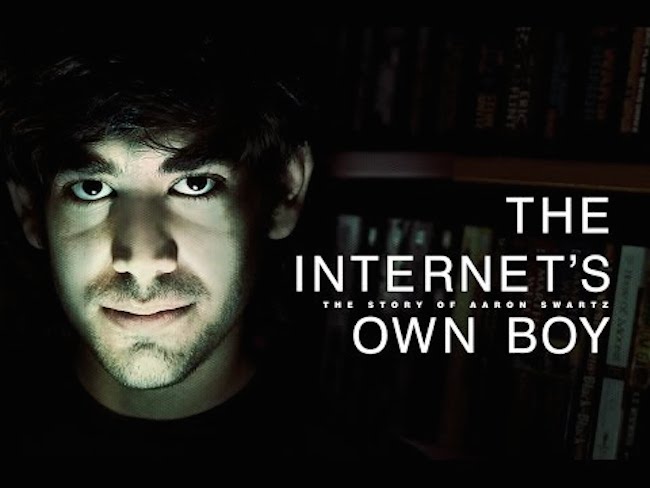
Watch This Film About Why Aaron Swartz Matters More Than Ever


Aaron Swartz was a young, bright genius who believed in the open Internet. A self-made millionaire by the age of 19, he co-founded Reddit, was part of the creation of RSS and became a political organizer and Internet hacktivist who was instrumental in the fight against SOPA.
The Internet’s Own Boy, a film first released at Sundance and now opening to the public today, follows the story of his life and his tragic suicide in 2013 at the age of 26.
Swartz had been in a two-year legal battle for using MIT’s network to systematically download 4.8 million academic journal articles from JSTOR. He was facing $1 million in fines and 35 years in prison. As Boing Boing’s Cory Doctorow put it, Swartz was being prosecuted for “taking too many books out of the library.”
Film director Brian Knappenberger, who crowdfunded the film on Kickstarter, believes this movie is more than just about Swartz’s life, tragic though it was. He says it’s a commentary on the system, the Internet and the challenges we as a society face to keep it free.
“Aaron’s rallying the troops against SOPA. He’s talking to a lot of people and on TV, but at the same time he’s going through his own private hell, taking away his personal freedom, his own money. The prosecutor put all this pressure on him and he couldn’t even talk about that and it was really isolating,”
Knappenberger, who previously wrote and directed “We Are Legion,” a film about hacktivism, happened to be on a panel with Wired reporter Quinn Norton about a week after Swartz’s death. Norton had just written an in-depth account about the federal investigation into Swartz.
“I began to notice this anger in the industry that was welling up from the net,” Knappenberger told me over the phone. Though he included a lot of moving parts in the story (Swartz was involved in quite a bit), Knappenberger said it was so striking to him that what had happened to Swartz was not uncommon in our criminal justice system.
The story of Aaron Swartz is not just about being an activist caught up in the legal system. It’s a fight between government and hacktivism. It’s about exploring new territory and protecting freedom for us all. As Knappenberger put it, “[Swartz] symbolizes a kind of choice. He is the Internet’s own boy.”
The film opens in theaters across the country and online today.
You can also sign the petition to counter federal attorney misconduct. Tell the Department of Justice #NoMoreAarons by clicking here.

Monday, February 18, 2013

In the Internet era, even a 64-year-old retired math teacher can become a threat to a large company

James Hookway/The Wall Street Journal Tan Bun Teet, center, at the Palace of Justice in December

Mining Firm, Ex-Teacher Battle Over Rare Earths
By JAMES HOOKWAY
Wall Street Journal
February 18, 2013

In the Internet era, even a 64-year-old retired math teacher can become a threat to a large company.

That, at least, is the experience of Lynas Corp. LYC.AU +0.82% For over a year, the Australian rare-earths mining company has come under fire from Tan Bun Teet and his band of tech-savvy campaigners on Malaysia's South China Sea coast.

The group, called Save Malaysia Stop Lynas, has disrupted Lynas's plans to open a refinery with a nimble, Internet-based campaign, drawing nationwide support through regularly updated blogs, Twitter feeds and a Facebook page. In a recent interview, Chief Executive Officer Nick Curtis said Lynas underestimated the extent to which the protesters had enlisted the organizing power of the Web, forcing the company to delay the opening of the plant until this past November, a full year behind schedule, and to raise money it didn't initially plan for.

Sydney-based Lynas, which is listed on the Australian Securities Exchange with a market value of 1.2 billion Australian dollars ($1.24 billion) appeared to be onto a winner when it broke ground for a new plant in Kuantan nearly five years ago. Global demand for materials such as lanthanum and neodymium was surging as the world's appetite for hybrid cars, wind turbines and ever-faster phones with better screens increased.

The prospect of weakening China's chokehold on 95% of the world trade in these critical elements helped convince Malaysia's government that the project would be a success. It offered the firm a 12-year tax holiday to set up shop in Pahang, the home state of Prime Minister Najib Razak.

Instead, construction of the $800 million Lynas refinery kicked off a debate with local residents about how to handle the low-grade radioactive waste that comes from processing rare-earth elements. The company and the Malaysian government say the plant is safe.

The clash is also now spilling over into national politics, as opposition firebrand Anwar Ibrahim incorporates the cause in his bid to topple the coalition that has governed this predominantly Muslim nation since independence from Britain in 1957. Elections are expected to be called this spring.

"If we can't challenge the government in the courts, then perhaps the election will change the game," says Mr. Tan, a wiry, methodical 64-year-old.

Rare earths are a group of 17 elements valued for their magnetic and conductive properties. While harmless by themselves, they are frequently found mixed with potentially dangerous radioactive ores such as thorium. Separating and refining them can be complex and messy.

That has raised alarm among Malaysians who fear the government hasn't done enough to ensure the safety of the Lynas plant. "We can't trust them to do what's right," said Yu Siew Hong, a young mother who lives near the new facility...

Mr. Tan, who serves as Save Malaysia Stop Lynas's spokesman, isn't your common variety of eco-warrior...

Their emergence is part of a trend of smaller and smaller groups targeting corporations and markets, rather than governments, to achieve their goals, sometimes with spectacular effects...

"Refining rare earths is a dirty business and we want people to know what it involves...

Lynas says it intends to process the radioactive waste into other materials, such as road surfacing, diluting it. The company plans to export the material to comply with Malaysia's requirements...

Sunday, August 08, 2010

Google, Verizon net pact has 'many problems' says FCC commish

UPDATE: Google/Verizon plan falls short on network neutrality.

FCC needs to get tough on network neutrality
San Francisco Chronicle
August 8, 2010

There's no way to put a positive spin on the latest news about network neutrality. The Federal Communications Commission has given up its attempt to broker a deal between telephone, cable and Internet companies that would preserve the freedom of the Internet...

The goal is to keep dominant carriers from overcharging for online access. Google and Verizon insist that what they're working on is not a backroom deal for their own benefit but instead a legislative proposal about how Internet content should be managed. All of this may be true - but it still doesn't look right.

Public interest and consumer groups didn't feel like they had much of a say in the commission's discussions, and they surely won't feel like they had much of a say in whatever proposal Google and Verizon bring to the table. This is a huge problem - the future of the Internet belongs to the public, not just a few companies.

The ideal solution would be for Congress to step in and provide a framework for net neutrality - preferably one that keeps the public interest at heart, not the demands of dominant Internet companies and carriers.

Thursday, April 22, 2010

Will Facebook win the war against Google and control the Internet?

See also Comcast opposes Internet freedom.

How Facebook Could Organize The Internet
Niraj Chokshi
The Atlantic
Apr 22 2010

Given its scale, Facebook could end up completely transforming the web and may have even won the war against Google. If enough sites buy in, Facebook would have helped set a standard that would usher in a long-awaited, new era, writes Newsweek's Barrett Sheridan:

Computer scientists have long envisioned a Web 3.0, a smarter Internet that understands the difference between objects, people, places, animals, etc. In other words, computers and servers should know that Eternal Sunshine of the Spotless Mind is an object, and in particular it's a film, and in particular a film by Michel Gondry, who is a person. Right now computers see words like "Michel Gondry" only as dumb, meaningless text. Facebook wants to change that--which is great. But it also plans to own that information--which is scary.

Privacy concerns abound and could block Facebook's march to control the web. So could other companies if they refuse to participate. But Facebook's plans are ambitious and, if it succeeds, it could become more than just a social network...

Sunday, September 20, 2009

Good news for Net Neutrality: big companies won't be able to eliminate voices

FCC 'Net Neutrality' Rules Expected to Advance on Vote
By Cecilia Kang
Washington Post Staff Writer
Monday, September 21, 2009

The Federal Communications Commission's proposal of new rules to prevent companies such as AT&T, Verizon and Comcast from deliberately blocking or slowing certain Web traffic is expected to advance with three votes out of the five-member agency, according to sources...

Saturday, November 29, 2008

Lawsuit settled; website wins freedom of speech case

Since school attorney Daniel Shinoff is suing me for defamation, I am always interested in stories like this one:

Gentle Wind Project Permanently ‘Becalmed’ by Lawsuit Settlement
November 11, 2006


Marking a landmark victory for freedom of speech, former members of Gentle Wind Project (GWP), Jim Bergin and Judy Garvey, husband and wife from Blue Hill, ME, are pleased to announce that they have written the terms for a Settlement Agreement that was requested by John “Tubby” Miller and Mary “Moe” Miller (AKA Panuthos/Carreiro), co-founders of GWP... The agreement ends 2 ½ years of lawsuits against the couple.

In an about turn from the GWP leaders’ determined verbiage in 2004 that they would take their case “to the Supreme Court” to force removal of the couple’s Internet stories, the Settlement Agreement insures that Bergin and Garvey will continue to operate, without interference of any kind, their website Wind of Changes...

Though the couple now admits to the unwanted stress they endured, at times, during the long lawsuit process, they quickly decided after being sued by the group that they didn’t want to live the balance of their lives with the regret of giving in to censorship.

“We have no regrets about our 3-year defense to maintain our public interest website,” say Bergin and Garvey, “even though it has been a serious hardship financially, physically, and emotionally. We couldn't ever imagine that the Millers would put themselves, and their activities, up for public viewing in a courtroom; yet their collective belief system, and apparent outrage at us for writing our personal stories, kept them going forward, spending hundreds of thousands of their donor’s funds.”...