For Immediate Release Contact: Lisa Cohen, 310-395-2544
November 12, 2014 lisacohencomm@gmail.com NCTQ Report Finds That Teacher Prep Coursework Is Easier Than That of Other Majors on College Campuses “Easy A’s and What’s Behind Them” Highlights Lack of Rigor in Teacher Preparation; Report Finds That 44% of Teacher Candidates Graduate With Honors While Only 30% of All Undergraduate Students Do So Washington, DC — A new report from the National Council on Teacher Quality (NCTQ) documents that education majors are significantly more likely to receive high grades and graduate with honors than students in other majors on the same campuses. The report, Easy A’s and What’s Behind Them, argues that the persistent lack of rigor in teacher education coursework is a disservice to future teachers and their students. By failing to signal the challenge and complexity of real teaching, these courses send too many graduates into the classroom woefully unprepared, thus diminishing the value of their investment in preparation. The report can be found here. NCTQ looked at graduation data for students from more than 500 institutions—where nearly half of all new teachers are prepared—and found that education majors are almost half again as likely as all graduating students to graduate with academic honors. “Teaching is one of the most difficult and demanding jobs there is,” said Kate Walsh, president of NCTQ. “Yet for reasons that are hard to fathom, it appears to be one of the easiest majors both to get into and then to complete. Our findings are provocative and disturbing, helping to explain why most new teachers are overwhelmed when they walk into the classroom. The situation is not fair to the kids who get assigned to new teachers, nor is it right to shortchange the teachers themselves— who through no fault of their own are not sufficiently prepared.” Easy A’s is the latest installment in a series of reports by NCTQ, each focusing on a different aspect of teacher preparation. These reports supplement NCTQ’s much broader Teacher Prep Review, which rates the quality of teacher preparation programs and is published by U.S. News & World Report. Easy A’s findings:
NCTQ’s analysis did not stop with an examination of grades, but also investigated why teacher candidates at so many colleges and universities might receive such high grades in professional coursework, even as many surveys report that new teachers frequently struggle to be effective despite their high grades. Ruling out a number of explanations, the analysis ultimately focused on the kinds of assignments that the candidates must complete. NCTQ analyzed the types of course assignments for 1,161 courses, both education and non-education (including business, psychology, history, nursing, economics and biology) across 33 institutions, finding two basic types of assignments. NCTQ termed these two types of assignments “criterion-deficient” and “criterion-referenced.” The prevalence of one type of assignment over another proves to be a powerful predictor of whether a course is more or less likely to lead to high grades. (This relationship was determined using a subsample of 499 courses for which the average grade is publicly available.) Courses where it is relatively easy to earn an "A" rely primarily on criterion-deficient assignments. Such assignments tend to be generally quite broad in nature, do not require demonstration or mastery of particular knowledge or skills, and are often subjective, asking only that students express an opinion. Courses where it is harder to earn an "A" tend to base grades more on “criterion-referenced” assignments, honing in more narrowly on specific knowledge and skills. These assignments are more objective in nature, with an understanding that some strategies are more effective than others in the classroom. (Examples of the two types of assignments can be found at the conclusion of the press release, with many examples taken from teacher preparation coursework in Sections 2 and 4, and Appendix D of the report.) “Criterion-deficient” assignments are overwhelmingly more common in education coursework than in the courses in other majors. In the average teacher preparation course, criterion-deficient assignments account on average for 71 percent of the grade, but in non-education coursework such assignments account for only 34 percent of the course grade. Based on this research, NCTQ makes a number of recommendations. Among them, teacher preparation programs need to examine teacher candidates' grades on their own campuses to align their grades with other majors, set common standards for what it takes to earn top marks, shift the balance of assignments from criterion-deficient to criterion-referenced, and award honors to only a limited percentile of top-performing candidates. About the National Council on Teacher Quality The National Council on Teacher Quality is a nonprofit, nonpartisan research and policy organization located in Washington, DC. Founded in 2000, the National Council on Teacher Quality is committed to restructuring the teaching profession, led by our vision that every child deserves effective teachers. NCTQ is committed to lending transparency to and increasing public awareness of the four institutions having the greatest impact on teacher quality: states, teacher preparation programs, school districts and teachers unions. Funding for NCTQ's Teacher Prep Review and related reports is provided by over 50 foundations, located in 22 states. What Others are Saying About Easy A’s and What’s Behind Them Dina Rock, a 5th grade language arts and social studies teacher from Ohio who was an advisor to the project, said, “Too often new teachers don’t know what they didn’t learn until they’re on their own, facing classrooms of children. Easy A’s explains what’s behind the painfully frustrating experience of too many new teachers.” Celine Coggins, Executive Director of Teach Plus, whose focus is ensuring that urban children are taught by effective, experienced teachers, said, “Every year thousands of bright college students go into education, committed to working specifically with children in poverty. Then we drive them away from the profession because we didn’t train them well. Kids who desperately need these new teachers’ energy and passion are the losers. If we want to be successful at educating at-risk children, we have to teach their teachers well.” Examples of Criterion-Referenced and Criterion-Deficient Assignments The distinction between these two types of assignments is not unique to teacher preparation coursework, but we focus on examples that could have been taken from teacher preparation because of the focus of NCTQ's work. In order to show that it is not difficult to add criteria to an assignment that is criterion-deficient to ensure that both teacher candidates and their instructors can focus more on critical content and skills, the two criterion-referenced are modifications of the criterion-deficient examples. An explanation of how the assignment has been improved to provide a better foundation for strong training is provided.
|


The Explorer Society of New York
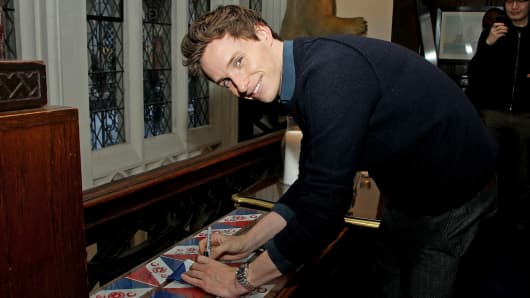
Eddie Redmayne is shown in this Nov. 19, 2014 photo.
Hollywood is being overtaken by mutants and meta-humans,
making it hard for a garden-variety astrophysicist to catch a break in
the movies.
With that in mind, even producing a vehicle about one of the world's most recognizable scholars was certainly no easy feat. That assessment comes directly from the man who wrote the script of author and scholar Stephen Hawking's biopic, "The Theory of Everything," which has been showing in theaters for nearly a month.
"It took 10 years to get this film off the ground," Anthony McCarten told CNBC in a response to emailed questions.
The difficulties of moving "Theory" from script to screen underscore the challenges facing art house movies, which are colliding with certain economic realities, he said. For scripts that don't feature well-known characters or A-list actors, the road to a green light can be even tougher, as big budget super heroes crowd out independent flicks.
"This was partly to do with the assumption that, no matter how compelling the central characters or how unprecedented their journey, physics and the travails of [Hawking's] disease…were almost certainly not going to be a recipe for big box office numbers," McCarten said.
Read MoreArtificial intelligence could end mankind: Hawking
With that in mind, even producing a vehicle about one of the world's most recognizable scholars was certainly no easy feat. That assessment comes directly from the man who wrote the script of author and scholar Stephen Hawking's biopic, "The Theory of Everything," which has been showing in theaters for nearly a month.
"It took 10 years to get this film off the ground," Anthony McCarten told CNBC in a response to emailed questions.
The difficulties of moving "Theory" from script to screen underscore the challenges facing art house movies, which are colliding with certain economic realities, he said. For scripts that don't feature well-known characters or A-list actors, the road to a green light can be even tougher, as big budget super heroes crowd out independent flicks.
"This was partly to do with the assumption that, no matter how compelling the central characters or how unprecedented their journey, physics and the travails of [Hawking's] disease…were almost certainly not going to be a recipe for big box office numbers," McCarten said.
Read MoreArtificial intelligence could end mankind: Hawking

The Explorer Society of New York
The screenplay charts Hawking's development as a young
physics student at the University Cambridge—where he is diagnosed with
amyotrophic lateral sclerosis (ALS) and given an initial prognosis of
two years to live—to his marriage and the penning of his definitive
tome, "A Brief History of Time."
When it debuted early this month, "Theory" arrived at an inauspicious time at the U.S. box office. The Thanksgiving to Christmas stretch normally gets swallowed by large budget, special effects heavy "popcorn" movies that serve as tentpoles for the major studios.
"Theory" was forced to share its premiere weekend with two movie juggernauts, "Interstellar" and animated film "Big Hero Six," which combined for a debut of more than $100 million.
Meanwhile, the fortunes of indie movies, even those with cultural icons like Steve Jobs at their core, are becoming prohibitively daunting as Tinseltown promotes a blitz of tentpoles. The 10 top-grossing independent movies of 2013 combined to earn more than $230 million, according to figures from Indiewire.com.
Read MoreSony Pictures drops Steve Jobs film
Still, that amount is barely a tenth of the $2.3 billion this year's box-office behemoths have reaped—all of which were science fiction, cartoon and comic adaptation spectacles like "Guardians of the Galaxy," "Captain America," and "Maleficent."
Conversely, independent movie makers are burdened with the task of challenging "the myth that audiences seek only spectacle," McCarten told CNBC.
"What they want, and have always wanted, is an immersive, emotional experience that surprises, delights and educates. How seldom these experiences involve airborne men in tights with special powers," he quipped.
When it debuted early this month, "Theory" arrived at an inauspicious time at the U.S. box office. The Thanksgiving to Christmas stretch normally gets swallowed by large budget, special effects heavy "popcorn" movies that serve as tentpoles for the major studios.
"Theory" was forced to share its premiere weekend with two movie juggernauts, "Interstellar" and animated film "Big Hero Six," which combined for a debut of more than $100 million.
Meanwhile, the fortunes of indie movies, even those with cultural icons like Steve Jobs at their core, are becoming prohibitively daunting as Tinseltown promotes a blitz of tentpoles. The 10 top-grossing independent movies of 2013 combined to earn more than $230 million, according to figures from Indiewire.com.
Read MoreSony Pictures drops Steve Jobs film
Still, that amount is barely a tenth of the $2.3 billion this year's box-office behemoths have reaped—all of which were science fiction, cartoon and comic adaptation spectacles like "Guardians of the Galaxy," "Captain America," and "Maleficent."
Conversely, independent movie makers are burdened with the task of challenging "the myth that audiences seek only spectacle," McCarten told CNBC.
"What they want, and have always wanted, is an immersive, emotional experience that surprises, delights and educates. How seldom these experiences involve airborne men in tights with special powers," he quipped.
Hawking his own super hero?
Hawking—a theoretical physicist and globally renowned
author—is certainly no ordinary mortal. Given a wealth of
accomplishments and a life story that personifies overcoming long odds,
one could easily make a case for Hawking being a superhero himself.
The emotional plot of "Theory" illustrates how a physically slight, brilliant academic who's self-confident enough to delve into the universe's deepest mysteries—not unlike Reed Richards of the "Fantastic Four" (also coming to a theater near you in 2015).
Simultaneously, Hawking conquers the ravages of a debilitating disease (Wolverine's healing factor, anyone?) while capturing the affections of his own version of Superman's Lois Lane. In the movie, Jane Hawking, played by Felicity Jones, seems to be one of the most comely women on Cambridge's campus.
"He's continually defied expectation, and there are many heroic qualities to him for sure," Eddie Redmayne, who played Hawking in "Theory", told CNBC in a brief interview in New York last week. "It was a real treat to get to enter his orbit."
But in an environment where even the story of Margaret Thatcher, the world bestriding former U.K. prime minister, can barely crack $100 million in movie ticket receipts, does a Cambridge scholar stand a reasonable chance to earn both accolades and ticket sales?
Read MoreEven 'Big Heroes' need big hearts: Disney
Although "Theory" has pulled in a scant $4 million in sales domestically, McCarten insists indie films can still carve their own niche—and stand alongside the computer generated images of their big-budget counterparts.
"Of course there is a market, and every year the point is made again and again, in people's hearts and at the Oscars and at the box-office, that people want inspiring true stories," he said.
"My job, and the job of everyone interested in grown-up film-making, is to make sure we get it to them: certified fresh, dazzling, remarkable and…true," McCarten added.
The emotional plot of "Theory" illustrates how a physically slight, brilliant academic who's self-confident enough to delve into the universe's deepest mysteries—not unlike Reed Richards of the "Fantastic Four" (also coming to a theater near you in 2015).
Simultaneously, Hawking conquers the ravages of a debilitating disease (Wolverine's healing factor, anyone?) while capturing the affections of his own version of Superman's Lois Lane. In the movie, Jane Hawking, played by Felicity Jones, seems to be one of the most comely women on Cambridge's campus.
"He's continually defied expectation, and there are many heroic qualities to him for sure," Eddie Redmayne, who played Hawking in "Theory", told CNBC in a brief interview in New York last week. "It was a real treat to get to enter his orbit."
But in an environment where even the story of Margaret Thatcher, the world bestriding former U.K. prime minister, can barely crack $100 million in movie ticket receipts, does a Cambridge scholar stand a reasonable chance to earn both accolades and ticket sales?
Read MoreEven 'Big Heroes' need big hearts: Disney
Although "Theory" has pulled in a scant $4 million in sales domestically, McCarten insists indie films can still carve their own niche—and stand alongside the computer generated images of their big-budget counterparts.
"Of course there is a market, and every year the point is made again and again, in people's hearts and at the Oscars and at the box-office, that people want inspiring true stories," he said.
"My job, and the job of everyone interested in grown-up film-making, is to make sure we get it to them: certified fresh, dazzling, remarkable and…true," McCarten added.